5 Signs Your Subfloor Needs Repair Before New Flooring Installation
HB Flooring Team
Installation Experts
The Most Expensive Mistake in Flooring: Ignoring What's Underneath
Picture this: you've chosen the perfect vinyl plank flooring in a gorgeous warm honey tone. You've hired an installer. The old carpet is ripped out. And then you see it — dark water stains, soft spots, and seams that look like tiny mountain ridges running across the plywood.
This is the moment that separates a renovation success from a renovation nightmare. Because here's the uncomfortable truth: your new flooring is only as good as the subfloor beneath it.
At HB Flooring, we inspect the subfloor on every single project before a plank goes down. In our experience across hundreds of Toronto installations, roughly 60–70% of homes — especially those built before 1990 — need some degree of subfloor preparation. Here are the five warning signs we look for, what causes them, and how we fix them.
What Is a Subfloor, and Why Does It Matter?
Your subfloor is the structural layer between your floor joists (the wooden beams supporting your floor) and your visible flooring. In most Toronto homes, it's made of:
- Plywood (older homes): Typically 5/8" or 3/4" thick. More dimensionally stable, but susceptible to delamination when wet.
- OSB (Oriented Strand Board — newer homes): Made from compressed wood strands. Cheaper than plywood but more vulnerable to moisture damage — once OSB swells, it never returns to its original shape.
- Concrete slab (basements): A completely different beast. See our basement flooring guide for concrete-specific preparation.
Modern floating floors — luxury vinyl plank and laminate — rely on click-lock mechanisms that demand a flat, stable, and dry surface. Even small subfloor problems create cascading failures: clicks that pop open, planks that rock like seesaws, and gaps that widen over time.
Sign #1: Excessive Squeaking and Creaking
What You'll Notice
A minor squeak here or there is completely normal in wood-framed houses — especially in Toronto homes that endure dramatic seasonal humidity swings (from under 20% in winter with forced-air heating to over 70% in summer). However, loud, consistent squeaking when you walk across a room is a red flag.
What's Happening
The subfloor panels have pulled away from the joists beneath them. As you walk, the loose subfloor flexes and rubs against the nails or screws that originally held it in place. The friction creates the squeak. Over time, this movement also creates unevenness as the panels shift.
The Fix
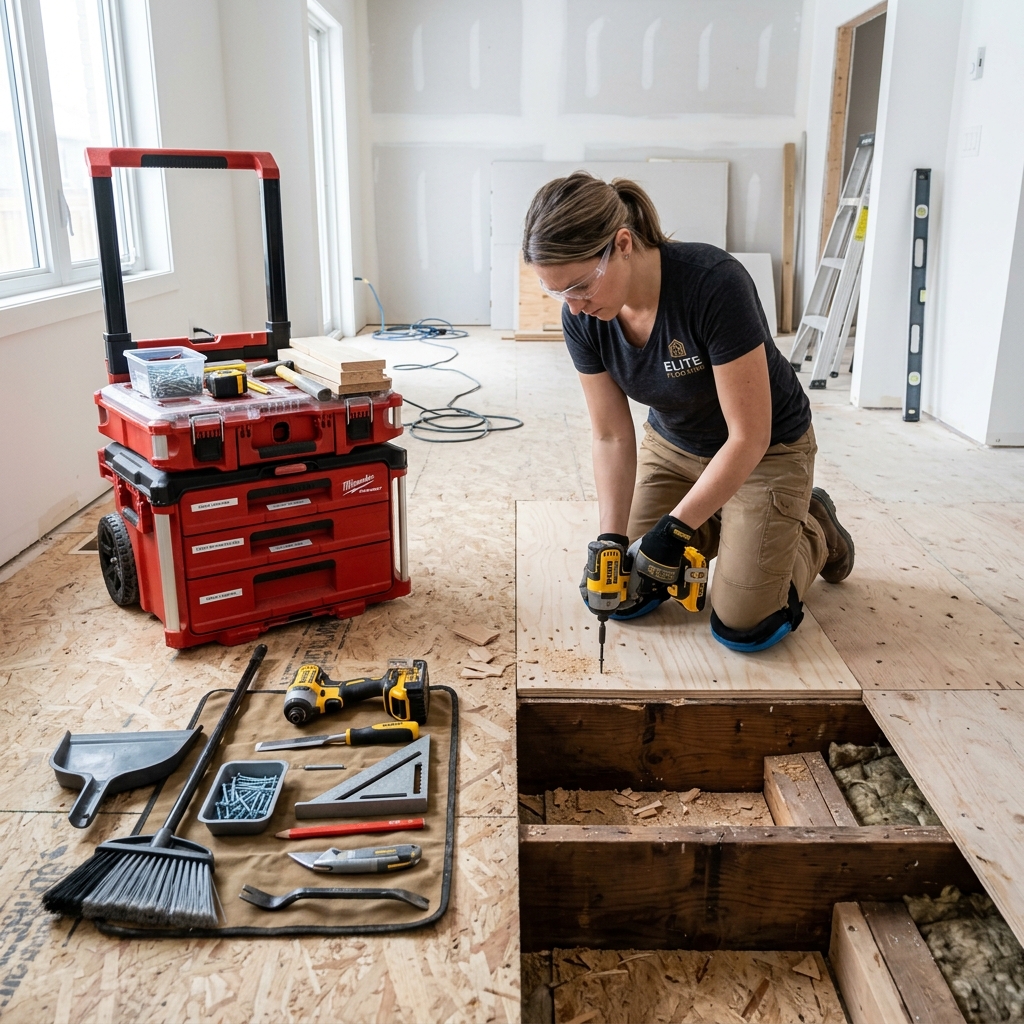
We systematically screw the subfloor back into the joists using construction screws every 6–8 inches along each joist line. This is a non-negotiable step before any new flooring installation. The good news: it's relatively inexpensive ($1.00–$2.00 per sq ft) and dramatically improves the feel and sound of your finished floor.
Sign #2: Spongy or Soft Spots
What You'll Notice
When walking across the floor, you feel a section that "gives" or dips slightly under your weight — as if you're stepping on a soft spot in the ground. It may feel spongy, bouncy, or unstable.
What's Happening
Soft spots are almost always caused by water damage. At some point, water infiltrated the subfloor — from a plumbing leak, an overflowed toilet, a roof leak, or condensation — and caused the wood to rot, delaminate (in plywood), or disintegrate (in OSB). The structural integrity of that section is compromised.
The Fix
There is no shortcut here: the damaged section must be cut out and replaced with new plywood of the same thickness. Our team cuts the damaged area back to the nearest joist on either side, installs blocking if needed for additional support, and screws in a new panel. For extensive damage, we may need to replace entire sheets.
In older Toronto homes — particularly those built in the 1950s–1970s — we frequently discover water damage around bathrooms, kitchens, and beneath windows. This is why we always recommend pulling up old flooring before providing a final quote: you can't assess a subfloor through carpet.
Sign #3: Visible Water Stains or Musty Smells
What You'll Notice
When old carpet, laminate, or vinyl is removed, you see large, dark water rings, discoloration, or white mineral deposits on the subfloor surface. You may also notice a damp, musty odor — the unmistakable smell of mold.
What's Happening
Water stains indicate past (or ongoing) moisture exposure. Even if the wood feels dry today, it may have lost structural integrity. More critically, the musty smell signals mold growth — likely on the underside of the subfloor or between the subfloor and joist cavity.
The Fix
Minor surface staining on structurally sound wood can be treated with a mold-inhibiting primer and sealed. However, if the wood is soft, spongy, or the mold is extensive, those sections must be removed and replaced. In severe cases, a professional mold remediation company should be involved before any new flooring is installed.
Important: Never seal mold beneath new flooring. It will continue to grow, potentially affecting indoor air quality and eventually destroying the subfloor entirely. This is especially critical in Toronto basements and bathrooms where moisture is chronic.
Sign #4: Unevenness or Sloping
What You'll Notice
Visible dips ("birdbaths"), humps, or a general slope across the floor. You might notice a marble rolling across the room, doors that swing open or closed on their own, or existing flooring with visible high and low spots.
What's Happening
Several factors cause uneven subfloors in Toronto homes:
- Foundation settling: Over decades, foundations shift and settle unevenly, especially in older Toronto neighbourhoods built on clay-heavy soil.
- Joist deflection: Floor joists can sag over time, particularly in spans longer than 12 feet or when undersized joists were used (common in homes built before modern building codes).
- Previous patch jobs: Layers of old flooring, underlayment, or poorly applied patches can create an uneven surface.
The Fix
Modern floating floors (rigid core LVP and laminate) require an extremely flat surface — no more than 3/16-inch variance over a 10-foot span. We address unevenness with:
- Self-leveling cement compound: Poured over low spots to create a perfectly flat surface. This is the most common fix for concrete slabs and moderately uneven plywood.
- Sanding high spots: For minor humps, belt sanding the high areas can bring the subfloor into tolerance.
- Shimming joists: For structural sagging, we may need to shim the joists themselves to bring the subfloor plane level.
Leveling is one of the most common — and most important — preparation steps in Toronto flooring installations. It's also one of the main reasons professional installation costs vary between companies: cheap quotes often skip this critical step.
Sign #5: Lifting or Curling Panel Seams
What You'll Notice
Where two plywood or OSB sheets meet, the edges are swelling upward, creating a ridge or "tent" along the seam. You can feel it through thin flooring materials and sometimes even see it.
What's Happening
The exposed edges of the panel sheets have absorbed moisture and swelled. OSB is particularly notorious for this — once the edges swell, they never shrink back to their original size. This creates a ridge that will "telegraph" through your new flooring, creating a visible and tactile line in the finished floor.
The Fix
- Minor curling: The seams can be sanded flat with a belt sander. This works well for plywood with slight edge swelling.
- Moderate swelling (OSB): Sanding OSB creates a rough, fibrous surface that doesn't bond well with adhesives or lay flat under floating floors. In these cases, we apply a patching compound over the seams.
- Severe swelling: The affected panels must be replaced entirely. This is most common in homes that experienced flooding or prolonged plumbing leaks.
What Subfloor Repair Costs in Toronto
Budgeting for subfloor prep is essential. Here are typical costs:
- Re-screwing loose panels: $1.00 – $2.00/sq ft
- Self-leveling compound: $50 – $100 per bag (2–5 bags typical per room)
- Plywood panel replacement: $3.00 – $5.00/sq ft (includes removal, new plywood, and fastening)
- Full subfloor replacement: $5.00 – $8.00/sq ft (for severely damaged areas requiring joist work)
While these costs add to your project total, they are always worth it. A $500 leveling job protects a $5,000 flooring investment. Skipping it guarantees premature failure.
Why Professional Subfloor Assessment Matters
Here's the reality: you can't accurately assess a subfloor without seeing it. Carpet, old laminate, and existing vinyl hide everything. A subfloor that looks fine from above may be rotting from below. That's why HB Flooring always includes a thorough subfloor inspection as part of our free in-home consultation.
We pull up a small section of existing flooring (with your permission), check flatness with a 10-foot straight edge, test for moisture with professional meters, and look for every one of the five warning signs above. Only then do we provide a quote — because an accurate quote requires knowing what's underneath.
Don't Build Your Dream Floor on a Bad Foundation
Whether you're installing premium hardwood flooring in Toronto, luxury vinyl plank or laminate, your subfloor is the foundation that determines everything. Book your free in-home consultation with HB Flooring and let our team assess your subfloor before you invest a dollar in new flooring.
Ready to Upgrade Your Floors?
Get a free, no-obligation quote. Our experts will come to your home, take precise measurements, and bring samples right to your door.
Share this article
About HB Flooring
Toronto's premier flooring installation experts. Specializing in luxury vinyl plank, laminate, and hardwood for over 15 years.
Contact our team →